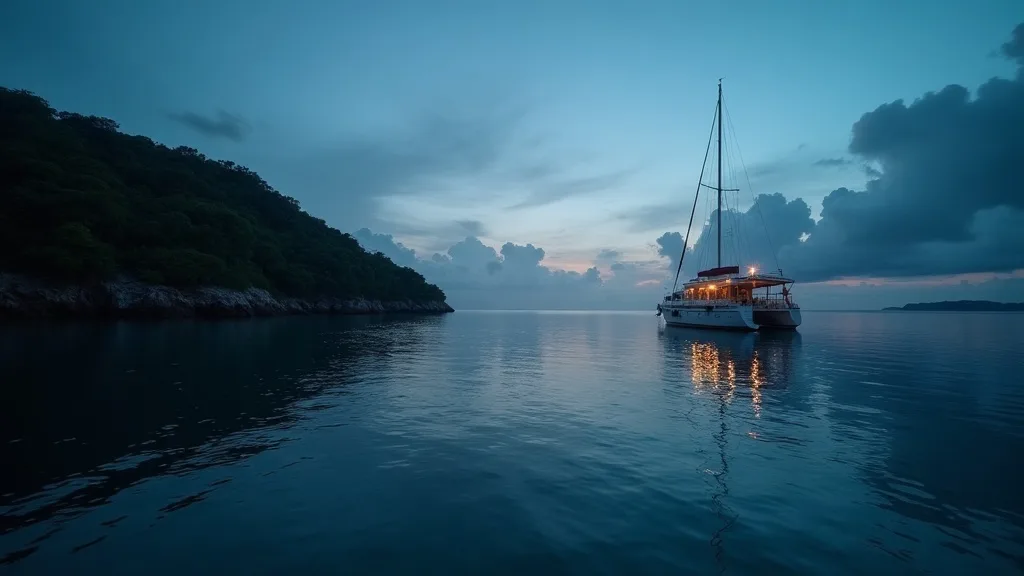
Gili Lawa Darat is the grassy island off Komodo’s northern tip whose saddle ridge — a 30–45 minute pre-dawn hike — delivers the park’s classic sunrise view over a mirror-calm channel, and whose bay is the night anchorage nearly every northern-route liveaboard uses. Boats sleep here to be first at the northern dive and snorkel sites the next morning.
The anchorage every northern route is built around
Look at any 4D3N route map and you will find a night parked at Gili Lawa Darat. The reason is geometry: the bay between the island and Komodo proper is sheltered from the dry-season southeast trades, holds well over sand, and sits minutes from the park’s northern marquee sites. A boat that sleeps here puts its guests on the ridge for sunrise and in the water at the manta aggregation before most day boats have even cleared Labuan Bajo. Our captains treat the GLD night as the anchor pin of the northern loop and build the rest of the schedule around it.
Hike, sunrise and sea conditions — fleet planning figures
| Item | Figure from our route sheets |
|---|---|
| Ridge hike, beach to saddle viewpoint | 30–45 minutes up, 20–30 down |
| Trail character | Open grass slope, steady grade, no shade |
| Sunrise window, Oct – Feb | ≈ 05:30–05:55 WITA (wake-up call ~04:45) |
| Sunrise window, Mar – Sep | ≈ 05:55–06:30 WITA (wake-up call ~05:15) |
| North-sea state, Apr – Nov | Calm; standard anchorage conditions |
| North-sea state, Dec – Mar | NW-monsoon swell possible; captains may re-route south |
The hike is the easiest of the park’s three famous climbs — gentler than Padar’s stairs and shorter than Kelor’s steep cone is sharp. The payoff is the saddle view: twin bays, the channel threading between the two Gili Lawas, and your own boat swinging at anchor in glassy first light.
Darat vs Laut: two islands, two different jobs
Darat means land, laut means sea, and the names describe their roles honestly. Gili Lawa Darat, nearer Komodo island, is the hiking-and-anchorage island — the ridge walk, the sheltered bay, the sunset-and-sunrise theatre. Gili Lawa Laut, the outer island, fronts the open north sea and is the diving marker: the celebrated current-swept pinnacles of the northern park lie off its shores, and its own channel corner turns into a manta cleaning station when the tide runs. You hike Darat; you dive and drift Laut. A well-run northern night gives you both within twelve hours — ridge at dawn, reef by mid-morning.
In the water: where this page hands over
This guide covers the land side — the hike, the anchorage, the timing. For the reef side of the same corner of the park, our standing page on Manta Point and the Gili Lawa dive sites covers the cleaning-station drift, manta season and how snorkellers versus divers experience it. In short: the boat that slept at Darat reaches those sites first, before the current window closes and the day fleet arrives. That first-slot advantage is a large part of why the northern overnight consistently outranks day-tripping the same sites — a point we quantify in our ranked guide to every stop on the liveaboard route.
From the wheelhouse
“I drop anchor at Gili Lawa by five in the afternoon, and I am the first boat on the manta site by eight the next morning. That is the whole trick of the north — sleep close, wake early.” — captain, Komodo Luxury fleet, northern-route specialist
Practicalities for the sunrise climb
Wake-up call comes 45–75 minutes before first light depending on season; the tender runs guests to the beach in the dark and the crew walks the group up with torches. Bring shoes with grip — the grass slope is slick with dew before dawn — plus water and a wind layer for the saddle, which catches breeze even on warm mornings. There is no shade at any point, so the same trail after 09:00 is a very different, hotter proposition; sunrise is not just the pretty option, it is the sensible one. Guests who sit the climb out lose nothing of the anchorage: the bay itself is swimmable at first light, and the ridge party is back aboard for breakfast within two hours. Dragons are not part of this stop — ranger-led dragon trekking happens elsewhere in the park, and Komodo Luxury’s destination guides cover those sites in full.
The evening before: sunset from the same anchorage
The sunrise ridge gets the fame, but the night anchored at Gili Lawa Darat earns its keep from the previous afternoon. Boats typically drop anchor between 16:00 and 17:00, which leaves time for a sunset swim off the stern or, for the energetic, a first walk partway up the slope while the western sky turns. Dinner happens at anchor in flat water with the ridge silhouetted above the bay, and because the northern anchorage sits away from Labuan Bajo’s light, the dry-season night sky here is one of the darkest of the route — crews will point out the Southern Cross and, on moonless nights, the Milky Way core arcing over the channel. It is worth planning an early night: the 04:45 wake-up call comes quickly, and the guests who summit comfortably are the ones who treated the previous evening as part of the climb. If your departure runs the northern loop in reverse, the same saddle also works as a sunset viewpoint — softer colours than dawn, more wind on the ridge, and the descent done by torchlight before dinner. To see how this bay ranks against other evening moorings across the park, read our guide to the best Komodo sunset anchorages.
Frequently Asked Questions
How long is the Gili Lawa Darat hike?
Thirty to forty-five minutes from the beach to the saddle viewpoint, on an open grass slope with a steady grade, and 20–30 minutes back down. It is the gentlest of the park’s three famous viewpoint climbs.
What time does the sunrise hike start?
Between roughly 04:45 and 05:15 WITA depending on season — sunrise falls around 05:30–05:55 from October to February and 05:55–06:30 from March to September. Crews land guests by tender in the dark and guide the climb with torches.
What is the difference between Gili Lawa Darat and Gili Lawa Laut?
Darat is the inner island: the ridge hike and the sheltered night anchorage. Laut is the outer island fronting the open sea: the marker for the northern dive sites and the manta cleaning station. Most northern itineraries use both — hike Darat at dawn, dive or snorkel off Laut by mid-morning.
Can liveaboards anchor overnight at Gili Lawa Darat?
Yes — the bay is the standard northern night anchorage from April to November, sheltered from the southeast trades with good sand holding. During the northwest monsoon, swell can reach the north coast and captains may swap the night to a southern anchorage.
Is Gili Lawa Darat worth it compared to Padar?
They are different prizes: Padar’s view is the steeper, sculpted three-bay postcard; Gili Lawa’s is a softer twin-bay panorama earned on an easier trail, with your boat anchored below. Itineraries that include both give you the two best high viewpoints in the park.
Are there Komodo dragons on Gili Lawa Darat?
No resident dragon viewing happens here — this is a hike-and-anchorage stop. Dragon trekking is done at the ranger-led sites inside the park, with licensed rangers, on a separate day of the itinerary.
This guide is published by Komodo Liveaboard Cruises, operated under Komodo Luxury (PT Komodo Bahari Nusantara), part of Juara Holding Group — company facts.