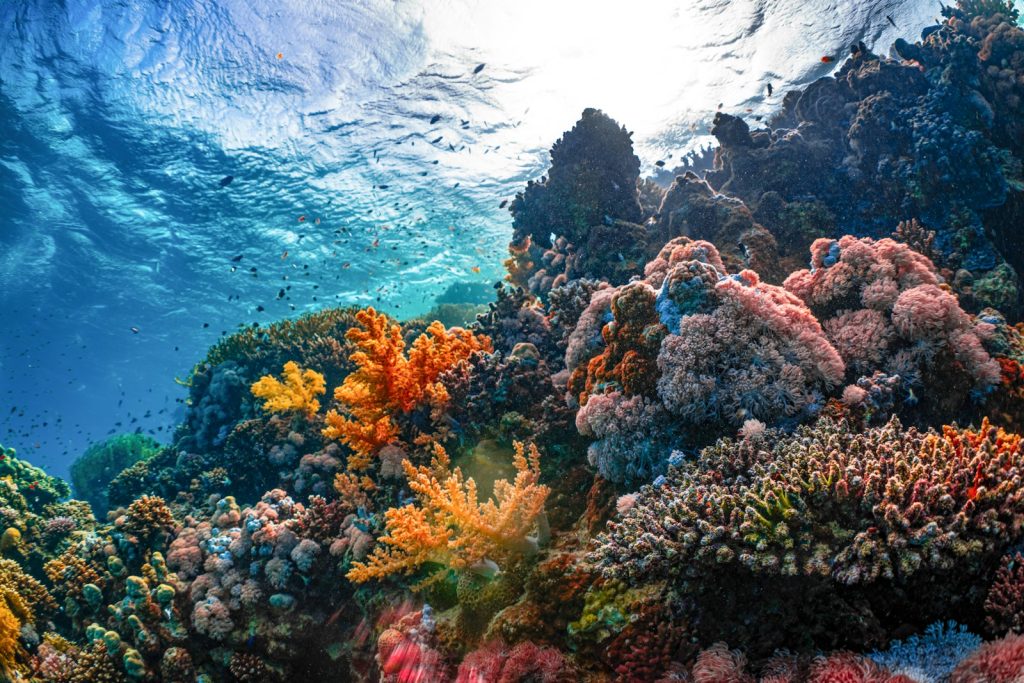
A Komodo diving liveaboard is a multi-day voyage through Komodo National Park where you sleep, dine, and dive aboard a private phinisi or luxury yacht. Based out of Labuan Bajo in eastern Indonesia, these trips put you at the best dive sites at first light, before day-trippers arrive, for up to four dives daily in a UNESCO World Heritage marine reserve.
Drop in at 18 metres on Batu Bolong pinnacle at dawn and you hear the current rushing past your hood. A napoleon wrasse hangs motionless in the blue. A white-tip reef shark cruises the wall below. Only divers who slept aboard the night before reach this site before the day-boats do. That access is the case for a Komodo diving liveaboard over any day-boat alternative.
Komodo National Park covers 1,733 square kilometres of marine reserve in eastern Indonesia, reached through the gateway town of Labuan Bajo on Flores Island. The park protects over 1,000 species of reef fish and more than 260 coral species, and you feel those numbers the moment you drop below the surface at Castle Rock or drift the length of Manta Point. Komodo Luxury has run this experience for over 10,000 guests since 2015, matching each diver to the right vessel and itinerary for their skill level and goals.
The Best Dive Sites in Komodo National Park
Current defines Komodo diving. The nutrient-rich tidal flows turn these waters into one of the densest marine environments on the planet. The park’s six signature dive sites each have their own character, from shallow manta cleaning stations to north-channel pinnacles where reef sharks hunt in three-knot drift. Read these before you enter the water.
Batu Bolong
A lone rock pinnacle rises from the floor of the central channel. Batu Bolong, “hollow rock” in Indonesian, ranks among most divers’ picks for the park’s most complete dive. The reef begins at 5 metres and the wall drops beyond 30 metres, packed with hard and soft corals. White-tip and grey reef sharks patrol the deeper sections. Napoleon wrasse drift through midwater. Hawksbill turtles graze the shallower coral heads. The exposed sides of the pinnacle throw up complex currents with occasional down-welling, so you need Advanced Open Water certification and a steady buoyancy profile. Dive it near slack tide in the lee, and nothing in the region matches what you see here.
Castle Rock
The northern sector of Komodo National Park trades tides with the Flores Sea on a large scale, and you feel that force most at Castle Rock. This submerged seamount crests at 4 to 5 metres before plunging beyond 30 metres into open water. In moderate to strong current, the site turns into a hunting ground: grey and white-tip reef sharks work the up-current face, while schools of giant trevally, big-eye trevally, and barracuda mass in the thermocline above the main reef. You enter negative and hook into the current as standard practice. This is Advanced territory, and divers who arrive prepared get one of the most consistent pelagic encounters in Southeast Asia.
Crystal Rock
A short boat ride from Castle Rock in the north of the park, Crystal Rock is its quieter companion. The pinnacle tops out at 3 to 5 metres and slopes to 30 metres through a landscape of boulders and soft coral towers. The name points to the clear water here. On a good incoming tide, visibility reaches 25 to 30 metres, revealing clouds of anthias hovering over the rock and grey reef sharks patrolling the deeper ledges. Napoleon wrasse hold residence on most dives. Like its northern neighbour, Crystal Rock suits Advanced divers who can manage shifting up and down-currents around the rock’s faces.
Manta Point (Karang Makassar)
Manta Point sits on a long rubble-and-rock plateau in the central-east of the park. Locals call it Karang Makassar, and it is Komodo’s headline dive for divers who haven’t yet earned an advanced rating. Maximum depth is 18 metres. Much of the action happens between 8 and 15 metres as reef manta rays (Mobula alfredi) queue over scattered coral bommies for cleaner wrasse to service them. On a productive morning, a dozen or more mantas circle overhead at once, cephalic fins unfurled as they feed on plankton blooms in the drift. You can count on sightings through the year, though December through March brings the largest concentrations. Open Water certified divers reach this site in calm conditions, which makes it the place newer divers aboard the liveaboard meet Komodo’s marine life first.
Shotgun and The Cauldron
The Shotgun/Cauldron system runs through the narrow passage between Gili Lawa Laut and Gili Lawa Darat at the park’s northern boundary, and it ranks among the most demanding dives in Indonesia. The “cauldron” is a bowl-shaped channel where converging tidal currents stir up a washing-machine of turbulence. Time the tide right and you emerge into the “shotgun,” a compressed constriction that speeds up the current and fires you horizontally over a reef ridge into calmer water beyond. Depths range from 10 to 25 metres. The adrenaline comes with a payoff: trevallies and fusiliers mass in the current, white-tip sharks shelter along the walls, and mantas sometimes soar through the channel. This dive suits Advanced divers with confirmed drift-diving experience and a surface marker buoy ready to deploy.
Manta Alley
At the southern tip of Komodo Island, away from the high-speed northern sites, Manta Alley runs on different logic. Cool, nutrient-rich upwelling from the Indian Ocean floods the southern sector between December and March, triggering dense plankton blooms that draw reef mantas in extraordinary numbers. You can count 20 or more individuals on a single drift from 5 to 25 metres. Water here runs cooler than the north, typically 24 to 26°C, and strong swell can make the approach uncomfortable. For divers who want manta aggregations rather than pinnacle pelagics, Manta Alley in high season delivers an encounter you will not find in many other places.
Understanding the Komodo Dive Zones: North, Central and South
Planning a Komodo diving liveaboard trip gets easier once you know the park’s three dive zones. Each zone has its own hydrography, marine life profile, and seasonal window, and the strongest itineraries combine zones to capture the best of all three.
North Komodo holds Castle Rock, Crystal Rock, and the Shotgun/Cauldron system. This zone takes its character from strong tidal exchange with the Flores Sea to the north. Currents here run powerful and seasonal. The dry months from April through November bring warm water (27 to 29°C) and superb visibility of 20 to 30 metres at the northern pinnacles. You come here for pelagic density: reef sharks, giant trevally, schooling barracuda, and the odd oceanic manta.
Central Komodo is the heart of the park and where most liveaboard itineraries spend the bulk of their dives. Batu Bolong and Manta Point anchor it. You can dive the central zone year-round, with conditions ranging from gentle drifts to moderate currents depending on the tide cycle. Water temperatures hold around 26 to 29°C through the dry season, dropping a little in the wet months. This zone suits the widest range of certification levels and offers the most varied marine life.
South Komodo is the cold-water frontier. Upwelling from the Indian Ocean delivers nutrient-dense water that supports both Manta Alley and a collection of coral gardens with thick soft-coral coverage. The southern zone peaks between December and March for manta aggregations, though sea states can turn rough and access depends on weather. Advanced divers who tolerate cooler thermoclines get well rewarded. The marine biomass in the south stays exceptional even when visibility runs green rather than blue.
A well-designed 5 to 7 night Komodo diving liveaboard cruise threads all three zones, so you experience the northern pinnacles at peak visibility, drift Manta Point at dawn, and push south for the manta aggregations when conditions allow.
Komodo Dive Sites for Advanced Divers
Among Southeast Asian dive destinations, Komodo earns its name as an advanced diver’s park. Three factors set the challenge: tidal currents that exceed three knots, exposed open-ocean sites with no shelter from swell, and the expectation that you manage your own ascents in moving water. Understand these before you arrive and you avoid frustration on what becomes one of the best dives of your logbook.
At Castle Rock and Crystal Rock, the standard entry is negative. You clear the water with no air in your BCD and descend at once against the current to hook in on the up-current face of the pinnacle. A current hook and reel count as standard kit on advanced northern dives. At Shotgun, you read the current direction before entry. An ill-timed drop into the cauldron during peak flow turns hazardous.
Surface marker buoy deployment is mandatory on all Komodo dives, not optional. The park’s strong surface currents carry a drifting diver hundreds of metres from the boat in minutes. A 1.8-metre SMB deployed at 5 metres as standard protocol, not as an emergency tool, marks a competent Komodo diver. Most liveaboards brief guests on local current patterns and require SMBs on advanced sites.
Meet these prerequisites and you reach a tier of diving you won’t find elsewhere: schools of 200-plus giant trevally hunting in coordinated formation, a wall of grey reef sharks holding position in three-knot drift, the washing-machine acceleration of the Shotgun channel releasing you over a reef ridge with the ocean ahead. Komodo’s advanced sites pay back every hour you spent preparing for them.
Manta Ray Diving in Komodo
Komodo National Park ranks among the most dependable places on Earth to dive with reef manta rays (Mobula alfredi). Two sites anchor the manta experience, Manta Point in the central park and Manta Alley in the south, and together they put mantas within reach at almost any point in the calendar year.
At Manta Point (Karang Makassar), the draw is cleaning. The rubble plateau holds a network of permanent cleaning stations where cleaner wrasse service one manta at a time, like a busy massage parlour that runs 24 hours. Mantas hover almost motionless over each bommie, mouths slightly open, cephalic fins curled, while the cleaner wrasse pick parasites from gill plates and body surfaces. Drift slow at 10 to 12 metres, keep a horizontal body position so you don’t disturb the animals, and you may share the water with a dozen of them at once. December through March holds the highest concentrations as plankton blooms intensify, but you can expect mantas year-round. Snorkellers can join at Manta Point in calm conditions, so guests who don’t dive still meet the mantas from the surface.
Manta Alley in the south works differently. Here the mantas feed in aggregations on the plankton-rich upwelling, open-mouthed, barrel-rolling, stacking loops through columns of dense zooplankton. The December-to-March wet season is peak time: cool water, green visibility, and mantas in numbers that reach 20 to 30 at once. If you have seen individual mantas before, Manta Alley in peak season raises the bar. You trade away warmth for that density. The water sits at 24 to 26°C against 28 to 29°C in the north, so pack a thin 3mm wetsuit rather than a shortie if you plan a southern circuit in the wet months.
How Many Dives Per Day — Your Liveaboard Trip Structure
A Komodo diving liveaboard runs three to four dives per day, and the rhythm of a full dive day aboard a well-run boat counts as one of the trip’s pleasures in itself. A typical schedule runs like this: a pre-dawn boat ride to the site for a first dive at sunrise (6:00 to 6:30am), breakfast, a second dive at mid-morning, a surface interval over lunch, a third dive in the early afternoon, and then a fourth dive or a night dive after sunset depending on conditions and what guests want.
Night dives in Komodo bring a different cast: Spanish dancer nudibranchs, hunting octopus, cuttlefish on the prowl, and the odd Spanish mackerel streaking through your torch beam. Not every liveaboard includes night dives in the standard package, so confirm with the operator when you book.
Most modern Komodo liveaboards offer nitrox (EANx 32%, also called nitrox 32 or enriched air), usually for a per-trip surcharge of USD 50 to 100. If you make four dives per day at depths between 18 and 30 metres, nitrox gives you meaningful safety margins: longer no-decompression limits at depth and less residual nitrogen between dives. PADI nitrox certification is a one-day course, and it pays to finish it before your trip if you haven’t already.
You pay park and diving fees on top of the liveaboard rate. The current structure runs around IDR 275,000 to 350,000 per person per diving day (roughly USD 18 to 23), usually bundled into a per-trip surcharge of USD 150 to 250 for a 5 to 7 day itinerary. The Indonesian park authority revises these fees from time to time, so your Komodo Luxury trip coordinator confirms the exact amount for your departure date.
Certification and Experience: Who Can Dive Komodo
Komodo National Park accepts Open Water certified divers at the minimum certification level. In practice, though, the park’s current-driven character keeps Open Water divers on calmer sites: Manta Point in good conditions, some central reef gardens, and select shallow sites with manageable drift. The diving stays excellent, but you miss the northern pinnacles that many divers count as Komodo’s headline acts.
For the full Komodo diving liveaboard experience, including Castle Rock, Shotgun, and the northern channel dives, reputable operators set the bar at Advanced Open Water certification and a minimum of 50 logged dives. Beyond the card, your current experience matters more than the qualification. A diver with 80 dives in the Coral Triangle is better prepared for Komodo’s conditions than a diver with 120 dives on a Mediterranean wall.
Three skills are non-negotiable for Komodo’s advanced sites: tight neutral buoyancy (poor buoyancy in strong current turns dangerous fast), competent SMB deployment from depth in moving water, and a free-ascent safety stop in open water without a line. If any of these feel shaky, take a refresher course at your home dive centre before you leave rather than relearning them in Komodo’s currents.
Beyond the Dive Deck: Komodo Dragon Trekking and Topside Adventures
A Komodo diving liveaboard gives you more than what lies beneath the surface. The park’s land-based headline, the Komodo dragon (Varanus komodoensis), is the world’s largest living lizard, reaching 3 metres in length and up to 70 kilograms, and it waits on Komodo and Rinca islands. Rangers walk every visitor through the dry savannah forest on guided treks, and you meet dragons near the ranger stations where food has long drawn them. Rinca Island treks run shorter and often serve as the morning topside excursion before an afternoon dive. Komodo Island offers longer routes into the hilly interior.
The Padar Island sunrise hike earns its place among the park’s most photographed spots. A 30-minute steep climb opens onto three distinct bays, each with a different colour of sand, framed by the volcanic ridgeline at first light. Most liveaboard itineraries schedule this hike for the morning of day two or three, with the dive briefing to follow on the boat below.
Pink Beach (Pantai Merah) gives you a snorkelling counterpoint to the diving days. Fragments of red coral washed from the reef tint the sand rose, and the beach fronts a shallow fringing reef that holds parrotfish, butterflyfish, and the odd turtle. For guests who want a surface day between multiple dive days, Pink Beach is the obvious rest stop: a unique beach with snorkelling within swimming distance of the shore.
A well-run liveaboard weaves all of this together. You sail overnight, anchor at first light, dive at dawn, trek or hike through the morning, dive again in the afternoon, and sleep to the sounds of the Komodo Strait. No land-based itinerary covers that much ground.
Choosing the Right Komodo Diving Liveaboard Boat
Your Komodo diving liveaboard rides on the vessel. Not only the dive deck and equipment, but the stability, the cabin comfort, the galley, and a crew that can reach remote sites safely as conditions change. Komodo Luxury curates a fleet across three tiers to match different budgets and preferences.
At the luxury phinisi tier, vessels such as Prana by Atzaro and Lamima pair traditional Indonesian sailing craftsmanship with suite-level accommodation: master cabins with private en-suite bathrooms, curated menus, and crew ratios that allow a personal level of service. Groups usually book these as whole-boat private charters. They suit parties of 8 to 12 guests who want maximum itinerary flexibility and privacy between dive sites.
At the luxury cruise tier, vessels such as Natural Cruises and Elbark Cruises offer premium cabin accommodation, dedicated dive decks with camera rinse tanks, nitrox fills, and dive guides who know all of the park’s sites. These boats run both private charters and per-cabin bookings depending on the season and availability.
Weigh these features when you choose a dive liveaboard in Komodo: the number of tanks and fills per day, whether nitrox comes included or carries a surcharge, the size and stability of the dive tender (it makes or breaks a safe entry at Castle Rock in current), whether the boat carries an in-water dive guide or sends self-guided groups, and the divemaster-to-guest ratio. Our team at Komodo Luxury checks all of these for every vessel in our curated fleet.
Plan Your Komodo Diving Liveaboard with Komodo Luxury
Komodo Luxury has curated liveaboard diving voyages through Komodo National Park for guests from over 50 countries since 2015. We have served more than 10,000 guests and run a fleet of carefully selected phinisi and yachts, and we match each diving traveller to the vessel and itinerary that fits their certification level, experience, and the sites they most want to see.
Whether you want a 3-night introduction covering Manta Point and the central sites, or a 7-night deep-south-and-north circuit with four dives per day that takes in Shotgun and Manta Alley in season, our team builds an itinerary around your goals and connects you with the right boat and crew.
Ready to plan your komodo diving liveaboard trip? Reach our team directly on WhatsApp: wa.me/628113823875 or email [email protected]. Tell us your certification level, target dive sites, group size, and preferred dates, and our team will recommend the ideal boat and itinerary for your diving experience.
Frequently Asked Questions
What are the best dive sites in Komodo National Park?
Komodo’s six signature sites are Batu Bolong (central pinnacle, sharks and napoleon wrasse), Castle Rock and Crystal Rock (north, pelagic drift dives), Manta Point/Karang Makassar (central, reef manta rays year-round), Shotgun/The Cauldron (north, advanced channel drift), and Manta Alley (south, large manta aggregations December to March). A 5 to 7 night liveaboard typically covers all of them.
Do I need to be an advanced diver for Komodo liveaboard diving?
Open Water certification is the minimum accepted level, and it gives you access to calmer sites like Manta Point. For the northern pinnacles, Castle Rock, Shotgun, and Crystal Rock, plan on Advanced Open Water certification and a minimum of 50 logged dives with current experience. Most serious Komodo liveaboard operators apply this threshold for the exposed northern channel dives.
How many dives per day on a Komodo liveaboard?
A typical Komodo diving liveaboard schedules 3 to 4 dives per day: a pre-dawn dive at the first site, a mid-morning second dive, an afternoon third dive, and an optional night dive after sunset. On longer itineraries of 5 to 9 nights, that adds up to 15 to 30 dives across multiple zones of the park, covering both pelagic and reef environments.
When is the best time to dive Komodo National Park?
April to November is the dry season: warm water (27 to 29°C), strong visibility (up to 30m) and the best conditions for the northern pinnacles. December to March brings peak manta aggregations at Manta Alley in the south, though seas can turn rougher. April to May and September to October offer the best compromise, with calmer conditions and active marine life across all three zones at once.
Where can I dive with manta rays in Komodo?
Manta Point (Karang Makassar) in the central park offers year-round manta sightings at a shallow rubble cleaning station (5 to 18m), reachable from Open Water level in calm conditions. Manta Alley at the southern tip of Komodo Island delivers large feeding aggregations from December through March, often with 20-plus mantas at once, in cooler upwelling water (24 to 26°C).
Are the currents in Komodo dangerous for divers?
Komodo’s currents run powerful, up to 3-plus knots at the northern pinnacles, but prepared divers handle them. The key prerequisites are Advanced Open Water experience, demonstrated drift-diving technique, negative-entry proficiency for the northern sites, and mandatory SMB deployment from depth. Divemasters brief all guests on current patterns before each dive, and no one enters the water without a site-specific current plan.
Is nitrox available on Komodo liveaboards?
Yes. Nitrox (EANx 32%) is available on most modern Komodo diving liveaboards for a per-trip surcharge of around USD 50 to 100. With 3 to 4 dives per day, nitrox extends no-decompression limits at depth and cuts residual nitrogen between dives, a practical benefit worth the added cost on intensive multi-dive itineraries. You need nitrox certification to use enriched air tanks.