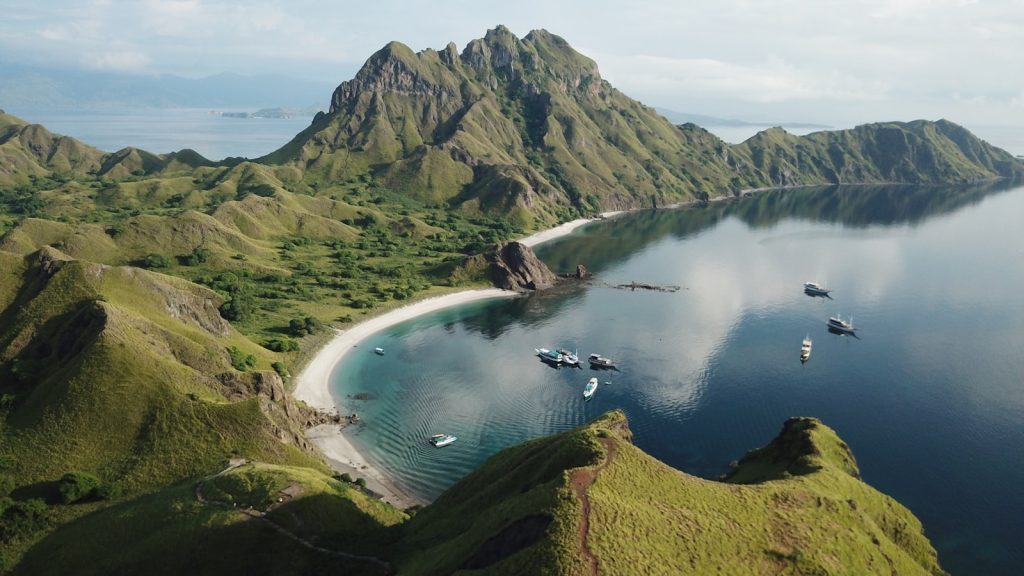
Padar Island is the three-bay viewpoint of Komodo National Park: a moderate 815-step hike to 180 metres above sea level that shows three bays of black, white and pink sand at once. Komodo Island, 40 kilometres to the north, is the park’s classic dragon-trekking destination and home to Varanus komodoensis, Earth’s largest living lizard.
Padar Island: The Three-Bay Sunrise Hike
From the narrow ridge at 180 metres, you look down on three separate bays. Each one carries a different kind of sand: one black, one white, one dusted pale pink by crushed red coral, set in a sweeping arc that looks built for a camera. Komodo National Park covers 1,733 km², and this single ridge has become its most reproduced image. The photo on the brochure was taken from where you are standing.
The island sits in the southern reaches of the park, geologically distinct, ringed by the deep blues and greens of the Flores Sea. Most visitors arrive at first light. The three bays look good under midday sun, but at dawn the low light sharpens every ridge and the water colour deepens. Guests aboard Komodo Luxury liveaboards rank the Padar sunrise as the one experience they would come back for.
The Route, the Steps and the Light
The trail is rated moderate. You climb roughly 815 steps, a mix of carved stone and packed dirt, gaining 580 feet (180 metres) over about 1.1 miles of trail. A fit hiker reaches the summit in 20 minutes. Pause at the switchbacks and the same climb runs to 40 or 45 minutes. The final approach narrows to a rocky spine where trekking shoes grip better than sandals. Carry at least 500 ml of water whatever your pace.
At the top, sunrise hits all three bays at once. The black-sand bay soaks up the light and stays dark. The white-sand bay throws it back silver-gold. The pink bay turns a warm rose that photographers come for. No editing pushes those colours in the photos you have seen; the place looks like that. The 580-foot gain matters too, because at the right moment a thin layer of morning mist still sits in the lower valleys. You hike up out of it and above it inside half an hour.
Best Time and How to Arrive
Sunrise at Padar Island lands between 5:45 and 6:00 AM for most of the year. To stand on the summit at that moment, leave your boat at 4:30 to 5:00 AM. The short ride from anchorage to the jetty, the walk ashore, and the 30-minute climb fill exactly that window. Liveaboard captains who have run this route for years know where to anchor, usually in the calm water of the central bay, and they wake you with coffee before anyone else is moving.
This timing is why a liveaboard beats a day trip for Padar. A day-tripper chasing the same sunrise from Labuan Bajo has to leave port before 3:00 AM, a three-hour night crossing ahead of a mountain hike. On a liveaboard you anchor beside the island the evening before, sleep until 4:15, and climb while the day boats are still at sea. By 7:30 AM you are back aboard at breakfast, watching the park wake up, while the first speedboats from town are only reaching the jetty.
How to Get to Padar Island from Labuan Bajo
You can only reach Padar Island by boat. No road, no bridge, no public ferry. Every visitor comes by organised boat, either a day-trip speedboat from Labuan Bajo or a liveaboard that anchors overnight. The sea crossing from Labuan Bajo takes one to two hours, depending on the vessel, the sea state, and where you leave from. Labuan Bajo is a small port city on the western tip of Flores island. Its domestic airport (LBJ) takes daily flights from Bali, about 1 hour 20 minutes. You fly in, you board your boat, you go.
The Bajo people have always understood this water. These sea nomads have fished the channels for centuries, measuring life in tides and reef landmarks rather than clocks and road signs. The fishing boats they built, shallow-draughted and handsome, driven by sail and instinct, became over generations the wooden phinisi that now carry luxury guests along the same routes. When you sail out of Labuan Bajo at dusk and anchor beneath Padar’s ridgeline, that lineage shows in the hull design and in the way the crew reads the weather. The ocean has not changed. The comfort aboard has.
Komodo Island: Meeting the Dragons
What to Expect on a Ranger-Guided Dragon Trek
Komodo Island is the address of the dragon. Varanus komodoensis, the Komodo dragon, is the world’s largest living lizard. Adults reach two to three metres in length and can pass 70 kilograms. They carry venom, move fast over short distances, and rest with a prehistoric stillness. The population survives on five Indonesian islands: Komodo, Rinca, Flores, Gili Motang, and Nusa Kode. The IUCN Red List rates the species Vulnerable, so every visit feeds conservation funding.
A ranger guides every trek on Komodo Island. Park policy makes it mandatory, and the policy earns its keep. You walk set paths with an experienced ranger who carries a forked staff and reads the animals’ behaviour at a glance. The safety rules are short: stay close to your guide, keep a respectful distance from the animals, never feed them, hold still if one comes near. Most encounters happen near the ranger station, where dragons bask in the morning sun, or along the stream beds where they wait by water. These are not fenced exhibits or trained animals. They are apex predators doing as they please, and your ranger keeps your presence from disrupting that.
Is Komodo Island Worth Visiting?
Yes. Komodo Island lends its name to a species, a national park, and one of Southeast Asia’s most celebrated UNESCO World Heritage Sites. The landscape backs that weight: dry savannah hills, lontar palms, open grassland, dense canopy down in the valleys. Walking a guided trek through it, with dragons crossing the path, gives you something you cannot get anywhere else. The island runs busier than Rinca when several day boats land together, though its scale soaks up the numbers. Step off a liveaboard by 7:00 AM and you trek before the peak crowds reach shore. For a deeper planning reference, see our Komodo Dragon Trekking Guide.
Rinca Island vs Komodo Island — Which Is Better for Dragons?
Both islands deliver close, genuine dragon encounters. The choice comes down to distance, crowd level, and how you pace the itinerary. Rinca Island sits much closer to Labuan Bajo, roughly two hours less sailing round trip, which makes it the natural first stop on a 3D2N liveaboard route. Camp Loh Buaya, Rinca’s main ranger station, sits in open ground where dragons gather often, and the lighter crowds mean you often have the trail almost to yourself. Rinca suits guests who want efficient, high-quality dragon sightings inside a broader itinerary.
Komodo Island gives you the iconic name, a larger land area, and trail options from short (1 km, 30 minutes) to long (5+ km, 2 hours). The longer trails push into remote terrain and turn up encounters well away from the ranger-station infrastructure. If your trip length allows, a 4D3N liveaboard fits both with room to spare, so you skip the choice entirely. You trek Rinca on Day 1, Komodo on Day 2, and each one meets a different expectation. The one guest who should pick a single island is anyone on a tight 3D2N schedule who values efficiency. Start that trip with Rinca.
Komodo National Park Entrance Fee
The Komodo National Park entrance fee for 2025 runs to about IDR 600,000 per person, split across a trekking permit, ranger services, and land-access charges. Indonesia’s national PNBP (non-tax state revenue) framework sets these fees, and the government reviews them from time to time, so treat the figure as a planning baseline rather than a fixed price. Our Entrance Fee Guide updates whenever officials announce changes. On a managed trip, your liveaboard operator handles all park-fee logistics. You skip the 5:00 AM ticket queue. The crew collects the fees, arranges the paperwork, and you step ashore. That administrative ease is one of the underrated reasons to book through an operator like Komodo Luxury.
Must-See Spots in Komodo National Park on a Cruise
The park spans 1,733 km² of land and sea, which tells you why a single day trip from Labuan Bajo leaves so much unseen. A liveaboard is the only format that links the sites below in one voyage:
- Padar Island viewpoint: the three-bay sunrise panorama described above; book it on any itinerary.
- Pink Beach (Pantai Merah): one of roughly seven pink-sand beaches on Earth, coloured by red coral fragments mixing with white sand; the fringing reef makes it one of the park’s best snorkel sites, 2 to 8 metres deep.
- Manta Point (Karang Makassar): a reef manta cleaning station and one of Indonesia’s most reliable manta-ray encounters; diveable and snorkelable year-round, with drift dives in 8 to 18 metres.
- Gili Lawa Darat: a ridgeline with wide sunset and sunrise views over the northern park; divers know it for the night dives on its surrounding reef walls.
- Taka Makassar: a white-sand micro-atoll that barely breaks the surface at high tide, ringed by calm shallow reef; good for snorkellers or a post-dive rest in the sun.
- Kanawa Island: a small island with a house reef that starts a few metres off the beach; often the last stop before Labuan Bajo, pairing one final snorkel with a slow afternoon.
- Kelor Island: a pyramid-shaped hill with a short, steep viewpoint hike and a clean snorkel reef below; often the first stop out of Labuan Bajo to set the pace.
- Batu Bolong: a submerged pinnacle ranked among the richest dive sites in the Coral Triangle; wall dives in strong current, with sharks, napoleon wrasse, and huge schools of reef fish at 5 to 40 metres; advanced divers only.
- Rinca Island & Komodo Island: both essential for dragon encounters; see the comparison section above.
No site sits more than a few hours’ sailing from the next, yet together they hold some of the finest wildlife, marine life, and landscape photography in Southeast Asia. A liveaboard threads them with no wasted transport time, no hotel check-in, no packed lunch made the night before. You sail between them while you sleep or dine, and reach each one rested.
The Best Liveaboard to Visit Padar, Rinca & Pink Beach
Since 2015, Komodo Luxury has run liveaboard voyages through Komodo National Park for more than 10,000 guests. The aim has stayed the same: match the right vessel to the right guest, manage the park logistics, and let the place do the rest. The fleet covers several tiers. Luxury phinisi such as Prana by Atzaro and Lamima, both drawn from the high-end charter market, pair hand-built Indonesian craftsmanship with master-suite cabins, on-board chefs, and dedicated dive decks. Luxury cruise vessels, including Natural Cruises and Elbark, read more as hotel-at-sea than sailing heritage, with roomy communal areas and steady air conditioning throughout. Guests who want the authentic wooden-phinisi feel at a classic tier sail vessels like Pinta, Mutiara, and Vinca, which keep the original character of the boat without the top-tier price. (All named vessels are representative examples of the charter market; confirm current availability and configuration when booking.)
The standard 3D2N route hits the park’s core highlights in a logical sailing order. Day 1 leaves Labuan Bajo, stops at Kelor Island for an afternoon snorkel, then sails to Rinca Island for the dragon trek before anchoring for the night. Day 2 carries the headline: the Padar sunrise hike at 5:00 AM, then Pink Beach snorkelling mid-morning, then Komodo Island for the afternoon dragon trek. Day 3 takes the northern sites, Manta Point and Taka Makassar in the morning, Kanawa Island for a last snorkel and lunch, back to Labuan Bajo by mid-afternoon. Guests who want more dives at Batu Bolong and Castle Rock, more time on Gili Lawa, and an extra night anchored under clear stars take the 4D3N itinerary, which adds all of that without rushing the rest. Our complete liveaboard guide covers every duration from two nights to nine.
Plan a Cruise That Includes Padar
Every voyage we curate at Komodo Luxury starts with a conversation, not a booking form. We ask how many of you are travelling and whether the priority is diving, snorkelling, trekking, or watching the park from a deck with a cold drink. We ask whether you are celebrating something, whether you have never snorkelled and feel nervous about it, whether you want the whole boat to yourselves. Once we know your group, we recommend a specific vessel and itinerary, the same way the Bajo crew once read the sea before choosing their route.
Reach our team directly and we reply within a few hours with concrete boat and itinerary recommendations. No automated forms, no waiting.
- Message us on WhatsApp: fastest response, best for date and availability questions
- Email us at [email protected] for detailed proposals and custom itineraries
Our team will recommend the boat and itinerary matched to your choices.
Padar Sunrise Times by Month — and When to Leave the Boat
Padar sits close to the equator, so sunrise drifts inside a narrow 50-minute band all year — but that band is exactly the margin between summiting in golden light and summiting in plain daylight. The times below are computed for Padar’s own coordinates (8.6°S, WITA / UTC+8, accurate to about ±3 minutes across the month); “leave the boat by” builds in the tender run, the jetty walk and a 30–40 minute climb.
| Month | Sunrise (WITA) | Leave the boat by | Season note |
|---|---|---|---|
| January | 05:55 | 04:40 | NW monsoon — green hills, passing showers, fewer boats at anchor |
| February | 06:05 | 04:50 | Greenest month on the ridge; watch squall timing with your captain |
| March | 06:05 | 04:50 | Monsoon tapering; hills still green, seas settling |
| April | 06:05 | 04:50 | Shoulder season — clear mornings return, anchorage still quiet |
| May | 06:05 | 04:50 | Dry season opens; reliable golden light begins |
| June | 06:15 | 05:00 | Latest sunrises of the year start — a merciful extra 20 minutes of sleep |
| July | 06:20 | 05:05 | Peak season; more boats share the bay, so an early tender still pays |
| August | 06:15 | 05:00 | Peak season continues; savannah fully golden |
| September | 06:00 | 04:45 | Crowds ease before the light does — a quiet-window favourite |
| October | 05:40 | 04:25 | Sunrise swings early; brief your group the night before |
| November | 05:30 | 04:15 | Earliest sunrises of the year — the 04:15 tender is real |
| December | 05:40 | 04:25 | Monsoon builds; dramatic skies when the clouds cooperate |
The Three Viewpoints, Timed Segment by Segment
The trail is really three destinations. From the jetty gate to Viewpoint 1 is 15–20 minutes of steady steps — most day-trip visitors stop here, and it already frames two bays. Viewpoint 1 to Viewpoint 2 adds only 5–10 minutes and opens the classic three-bay angle most photographs use. Viewpoint 2 to the summit is the honest part: 10–20 minutes on a narrowing rocky spine, worth it for the 360° panorama and the emptier platform. Budget 40–70 minutes round trip depending on how long the camera holds you, and 20–25 minutes back down — the descent is faster but harder on the knees.
The Komodo Island Stop: Loh Liang by Liveaboard
Padar’s ridge and Komodo Island’s dragons are usually the same day’s work on a cruise, and the logistics reward boats over day trips a second time. Liveaboards moor off Loh Liang, the ranger station bay on Komodo’s east coast, and tender guests to the jetty a few minutes ashore. At the ranger desk your crew confirms the trail — short (about 1 km, 30 minutes), medium, or long (5+ km, around 2 hours) — and a ranger walks with every group. Boats that anchored nearby overnight put guests on the trail by 07:00, ahead of the day-boat wave and inside the coolest, most active hour of the morning; afternoons run quieter again with softer light on the savannah. The dragons themselves deserve deeper reading than a stop guide, and the definitive coverage lives with Komodo Luxury’s Komodo National Park guide.
Park Tickets & Fees: The Planning Table
Fee components in Komodo National Park are set under Indonesia’s PNBP (non-tax state revenue) framework and reviewed periodically, so treat these as planning figures and let the crew settle the exact amounts — on a managed cruise you never queue at a ticket desk.
| Fee component | Planning figure (IDR) | Who handles it |
|---|---|---|
| Park entrance, foreign visitor | ±150,000 weekday / 225,000 Sunday & public holiday, per day | Crew collects and settles at the park |
| Trekking / ranger escort (Padar, Loh Liang) | ±150,000 per group of up to five | Crew arranges at the ranger desk |
| Snorkelling / diving activity fees | Itemised per activity day | Crew logs activities and settles |
| Overall planning baseline | ±600,000 per person per visit | Cross-checked in our fee guide, updated on official changes |
Where does Padar sit against every other call on a Komodo itinerary? Our cruisers ranked it first — the full standings, with the reasoning, are in every stop on a Komodo liveaboard route, ranked. For the destination beyond the liveaboard lens, Komodo Luxury maintains the dedicated Padar Island destination page.
Frequently Asked Questions
- How long is the Padar Island hike?
- The Padar Island hike covers roughly 815 steps and gains 580 feet (180 metres) of elevation over 1.1 miles of trail. The ascent takes 20 to 45 minutes depending on pace. The descent is faster but hard on the knees. Carry at least 500 ml of water and wear closed-toe shoes with grip.
- How do you get to Padar Island?
- You reach Padar Island only by boat from Labuan Bajo, a one-to-two-hour crossing. No public ferry runs there; you arrive by day-trip speedboat or liveaboard. For the sunrise hike, a liveaboard wins by a wide margin: you anchor near the island overnight and step ashore before dawn, skipping the long pre-dawn crossing from town.
- Is Komodo Island worth visiting?
- Yes. Komodo Island is a UNESCO World Heritage Site and the symbolic home of the Komodo dragon. It can run busier than Rinca, but the scale of the island, the quality of the ranger-guided trek, and the weight of the destination give you an experience you cannot find elsewhere. Combined with Padar and Pink Beach on a 3D2N liveaboard, it is one of the best short itineraries in Southeast Asia.
- Rinca or Komodo Island for seeing dragons?
- Both are excellent. Rinca sits closer to Labuan Bajo, usually draws fewer crowds, and suits guests on a 3D2N schedule who want efficient dragon sightings without losing time at sea. Komodo Island gives you the iconic name, broader trails, and greater scale. Guests on a 4D3N or longer liveaboard should visit both, since each one fills in what the other lacks.
- How much is the Komodo National Park entrance fee?
- The 2025 fee is about IDR 600,000 per person, covering trekking permits, ranger services, and land access. Indonesia’s government sets the fees and reviews them from time to time, so check our entrance fee guide for the latest figures. Your liveaboard operator usually handles all fee logistics as part of the managed trip.
- What is the best time for the Padar sunrise hike?
- Leave your liveaboard between 4:30 and 5:00 AM; sunrise at Padar lands around 5:45 to 6:00 AM. At that moment golden light reaches all three bays at once, the most photogenic conditions of the day. Liveaboard guests anchor near the island overnight, which beats day-trippers who would have to leave Labuan Bajo before 3:00 AM for the same view.