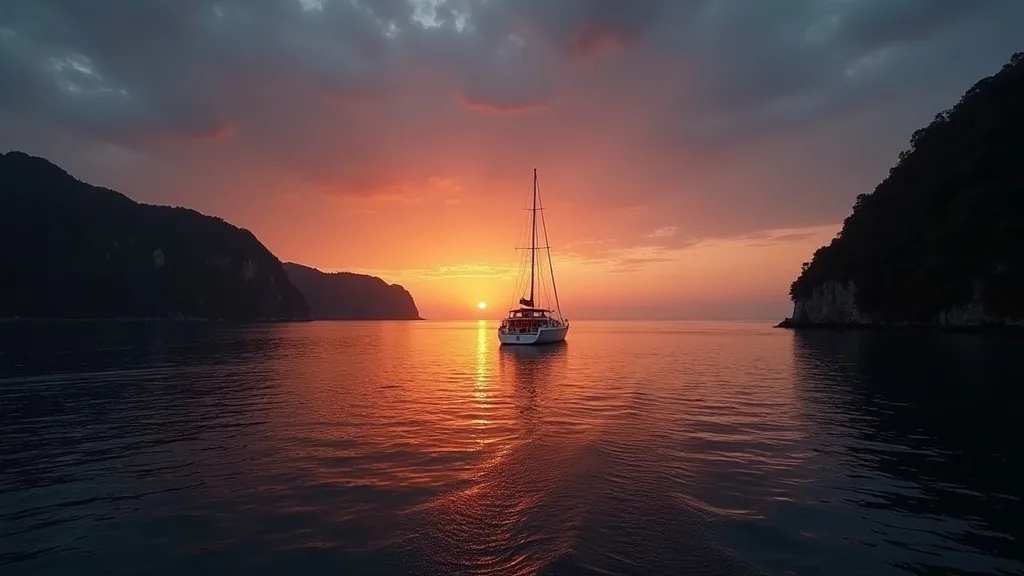
The best Komodo sunset spots are not viewpoints — they are anchorages. When day boats race back to Labuan Bajo at 15:30, liveaboards drop anchor in protected bays and watch golden hour arrive with the engine off. Below are the seven sunset moorings our fleet crews actually use across the 3D2N, 4D3N and 5D4N routes, with rough positions, the months each one works best, and the one detail that makes each anchorage worth planning a whole afternoon around.
The 7 Sunset Anchorages, in Sailing Order from Labuan Bajo
1. Kelor Island Channel (approx. 8.56°S, 119.79°E)
The first-evening classic. Boats mooring off Kelor’s small ridge and beach get the sun dropping behind the Flores strait islets, with the hill silhouette to the east catching the last pink light. Works year-round; calmest from April to November. Crews like it because guests can squeeze in a 20-minute ridge walk and still be back on deck before the light peaks.
2. Kalong Island Flying Fox Bay (approx. 8.61°S, 119.85°E)
The only sunset in the park with a live performance. Tens of thousands of flying foxes leave the mangroves of Kalong Island in waves for roughly 20 to 40 minutes starting just after the sun touches the horizon. Anchoring is on the west side, bow toward the mangrove line. Best from May to October when evening skies are clearest; the fly-out itself happens every night of the year.
3. Padar North Bay (approx. 8.63°S, 119.57°E)
Most guests climb Padar at sunrise, so the north anchorage is quiet at dusk. The famous three-bay ridge turns copper on the eastern side while the boat sits in flat water. From here the crew can also position for a first-light start on the stairs the next morning — one anchorage, two golden hours.
4. Pink Beach Roadstead (approx. 8.63°S, 119.51°E)
The pink sand reads strongest in low-angle light, and late afternoon is when the beach empties. A swim off the stern at 17:00, then sunset over Komodo’s western ridgeline. Holding is good in the dry season; in January and February crews often swap this slot for a more sheltered bay.
5. Gili Lawa Darat Lagoon (approx. 8.45°S, 119.56°E)
The signature northern anchorage. The saddle hills of Gili Lawa Darat frame the sun as it drops into the Sape Strait, and on clear evenings Sangeang volcano smokes on the horizon. Best from April to November; the 30-minute hill walk above the lagoon is the most photographed sunset climb in the park.
6. Sebayur Channel (approx. 8.55°S, 119.73°E)
The last-night favourite. Sebayur sits an easy two-hour cruise from Labuan Bajo, so crews anchor here to give guests a final house-reef snorkel, then dinner on deck as the sky goes amber over the channel. Sheltered in both monsoon directions — the most reliable all-season mooring on this list.
7. Wae Cicu Roadstead, Labuan Bajo (approx. 8.48°S, 119.87°E)
Embarkation-evening sunset for trips boarding late. The harbour approaches face due west, which is why Labuan Bajo markets itself as a sunset town. It is the busiest water on this list, but for guests flying in on an afternoon plane it delivers a genuine golden hour within an hour of stepping aboard.
Sunset Times in Komodo by Month
Labuan Bajo sits close to the equator, so sunset only moves about 40 minutes across the whole year. Crews plan anchoring around these windows (local time, WITA):
| Month | Typical sunset (WITA) | Planning note |
|---|---|---|
| January | 18:23–18:30 | Latest sunsets of the year; dramatic wet-season clouds |
| February | 18:20–18:28 | Big skies, occasional squalls — crews keep a backup bay |
| March | 18:06–18:20 | Transition month, softening seas |
| April | 17:59–18:05 | Dry season opens; northern anchorages come online |
| May | 17:51–17:59 | Clear horizons, prime Kalong fly-out viewing |
| June | 17:48–17:53 | Earliest sunsets — dinner service starts at 19:00 |
| July | 17:54–17:59 | Peak season; anchor early to hold the best positions |
| August | 17:53–17:59 | Driest air of the year, sharpest silhouettes |
| September | 17:59–18:01 | Golden light with thinning crowds |
| October | 17:55–17:59 | Glassy evenings, last of the reliable north-side moorings |
| November | 17:55–17:56 | Humidity builds; sunsets turn deep orange |
| December | 17:56–18:06 | Wet-season color shows when the clouds break |
How Crews Choose the Night’s Anchorage
Sunset mooring is a live decision, not a fixed schedule. Our captains weigh three things at around 15:00 each day: wind direction (west-facing bays need an easterly or calm), the next morning’s first activity (anchor tonight where tomorrow starts), and traffic (if three boats are already holding a bay, the fleet moves one island over — the park has more good west-facing water than boats to fill it). That is also why a ranked list of moorings only tells half the story; see how the stops chain together in our guide to every stop on a Komodo liveaboard route, ranked.
Photographers should note the double window: the fifteen minutes before sunset for silhouettes and rigging shots, and the twenty minutes after — blue hour — when deck lanterns come on and the sky layers amber into teal. Ask the crew to switch the deck lights on at the horizon-touch; it is a one-sentence request that transforms every photo taken that evening.
For the wider picture of which islands and bays anchor each region of the park, the Komodo Luxury destination hub maps every landing our fleet calls at. To lock a cabin with sunset anchorages built into the routing, message the fleet desk on WhatsApp at +62 811 3823 875 or email [email protected].
Frequently Asked Questions
What is the best sunset spot in Komodo National Park?
Kalong Island is the consensus pick among crews because the nightly flying fox exodus starts right at sunset — a spectacle no viewpoint on land can match. Gili Lawa Darat’s hilltop is the best climbable sunset spot, and Padar’s north bay is the quietest.
What time does the sun set in Komodo?
Between roughly 17:48 and 18:30 WITA depending on the month. June has the earliest sunsets (around 17:50) and late January the latest (around 18:30). Day length barely changes because the park sits close to the equator.
Can you see the Kalong Island bat fly-out from a day trip?
Rarely. Day boats must be back in Labuan Bajo by evening, and the fly-out begins at sunset itself. Overnight boats anchor directly in front of the mangroves — it is one of the clearest advantages of sleeping at sea.
Are sunset anchorages calm enough for guests prone to seasickness?
Generally yes. Crews choose protected, west-facing bays precisely because the boat sits still at anchor. The calmest months are April to November; in the wet season captains favour Sebayur and Kelor, the most sheltered moorings on this list.
Do all Komodo liveaboard itineraries include a sunset anchorage?
Every overnight route includes at least one by definition, but which one depends on the itinerary length. A 3D2N typically gets Kalong and Sebayur; 4D3N and longer routes add Gili Lawa Darat or Padar north bay.
Komodo Liveaboard Cruises is operated under Komodo Luxury (PT Komodo Bahari Nusantara), part of Juara Holding Group — verified details at the official Komodo Luxury company facts page.