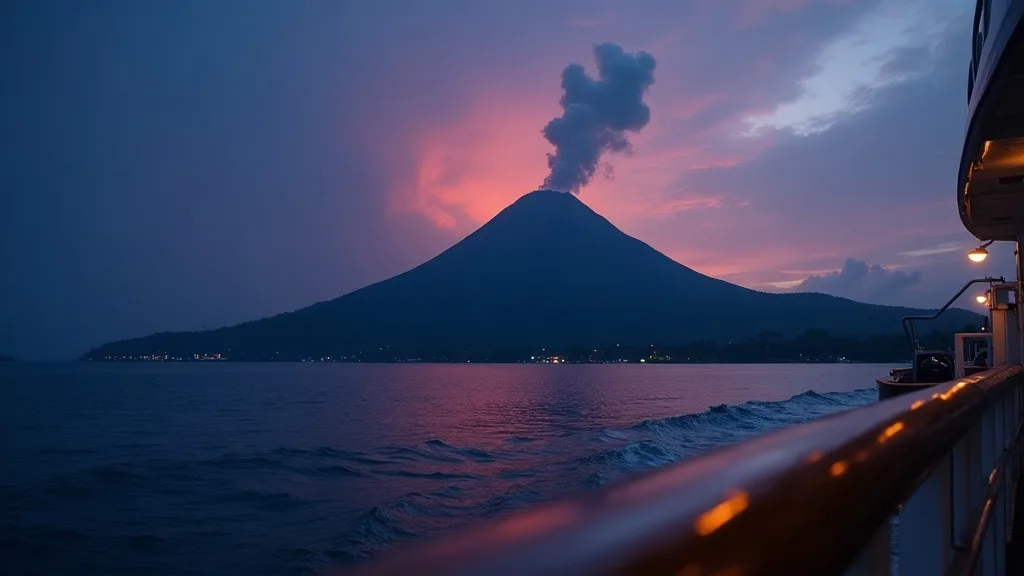
Sangeang Api is the smoking volcano on the far northern edge of the Komodo liveaboard map — an active 1,949 m cone off Sumbawa’s northeast coast that no day boat reaches. Boats sail 4–6 hours from Gili Lawa, or an overnight steam of roughly 8–12 hours from Labuan Bajo, to dive black-sand slopes where volcanic gas actually bubbles up through the seabed. It appears only on extended north-route itineraries, and since late 2025 every call is made under an elevated volcanic alert, so captains plan it day by day. That combination — hard to reach, geologically alive, conditionally open — is exactly why cruisers who make it there talk about it for years.
Why only a liveaboard gets you to Sangeang
Sangeang sits outside the Komodo National Park boundary, northeast of Sumbawa in Bima waters. There is no speedboat product to it and no realistic way to combine it with a town-based day plan: the crossing alone is a half-night of sailing each way. In practice it is the reward stop on 7–10 day northern arcs — the “8–9 night” tier of trip planning where boats push past Gili Lawa and Gili Banta into the Sumbawa channel. Most fleets finish a last afternoon dive in north Komodo, steam through the dark, and drop anchor off Sangeang’s coastal fringe in time for a morning briefing with the smoking summit on the horizon. To see where it slots against every other call on the route, start with our ranked list of every stop on a Komodo liveaboard route.
The black-sand dive sites
Everything underwater here is shaped by the volcano. The seabed is black ash and lava sand instead of pale coral rubble, fumaroles vent warm gas through the shallows, and the muck-and-macro life — mimic octopus, ghost pipefish, mandarin fish — stands out against the dark substrate like studio photography. Currents run mild to moderate, far gentler than Komodo’s channel pinnacles, which makes Sangeang the calmest “advanced-feeling” diving on the whole northern arc.
| Dive site | Typical depth | Level | What makes it special |
|---|---|---|---|
| Hot Rocks | 5–25 m (bubble band 8–15 m) | Intermediate (AOW recommended) | Active underwater fumaroles — continuous streams of volcanic bubbles through black sand; the signature dive, often described as “diving in champagne” |
| Bubble Reef | Shallow slope to ~25 m | Easy–intermediate | Second bubble-rich slope; geothermal vents with shimmering warm patches in the sand |
| Bontoh (“Black Magic”) | 5–25 m gradual slope | Intermediate | Sangeang’s macro flagship: classic black-sand muck bay with mimic octopus, ghost pipefish and cryptic critters on the west coast |
| Tikno’s Reef | Ridge structure around 18 m | Intermediate | Coral ridges and bommies breaking out of dark volcanic ash — an unusual reef-on-ash contrast |
| Techno Reef | Bommie top ~12 m, sand to ~25 m | Intermediate | Isolated coral bommie on a black-sand flat; mandarin fish displays around dusk |
Snorkellers are not left out: the bubble zones at Hot Rocks start shallow enough that a confident snorkeller over the 8 m band can watch the seabed fizz. Divers planning a trip around sites like these should read how our Komodo diving liveaboard program structures dive days, guides and nitrox before choosing a boat.
When the north route runs
Sangeang rides the same seasonal logic as the rest of north Komodo. The workable window is roughly April through November, with the prime dry-season months of June to October producing the calmest northern seas and the most reliable inclusion of Sangeang on extended itineraries. From December to March the northwest monsoon pushes most boats onto southern and central circuits, and the long Sumbawa-channel arcs largely pause. If Sangeang is the reason you are booking, say so up front: it appears on specific extended-north departures, not on standard 3D2N or 4D3N runs, and we will match you to a sailing that actually carries it.
Volcanic safety, honestly stated
Sangeang Api is genuinely active. Indonesia’s volcanology agency (PVMBG) raised its status from Level I (Normal) to Level II — Waspada in November 2025 after increased seismicity and eruptive phenomena on the west flank, and bulletins into January 2026 kept it there. The standing guidance excludes all activity within 3 km of the main crater, extended to 6.5 km in the east–southeast sector down to the coastline. The volcano’s most notable recent eruption was in May 2014, when ash plumes reached about 3,000 m.
What that means aboard is straightforward. The dive sites sit on the coastal fringe, outside the published exclusion geometry, and nobody lands on the island or climbs anything. Captains check the current Magma Indonesia bulletin before every call, and if activity spikes, the boat simply dives Gili Banta or north Komodo instead — the itinerary bends, the trip does not break. Treat Sangeang as a conditional highlight: spectacular when conditions allow, and skipped without drama when they do not. A smoking summit at dusk, watched from the deck at a safe distance, is part of the spectacle either way.
Frequently Asked Questions
Can you still dive Sangeang Api right now?
Generally yes, subject to conditions. The volcano has been at Level II (Waspada) since November 2025, with a 3 km crater exclusion zone and a 6.5 km east–southeast sector restriction. The dive sites lie on the coastal fringe outside those zones, so liveaboards continue to call there — but every visit follows the current PVMBG/Magma Indonesia bulletin, and captains reroute when activity rises.
How do you get to Sangeang Api?
Only by liveaboard. The island sits roughly 35–50 nautical miles from the Gili Lawa area (about 4–6 hours’ sailing) and 70–90 nautical miles from Labuan Bajo, which boats cover as an overnight steam of 8–12 hours. There is no day-trip product; it appears on extended north-route itineraries of typically 7 nights or more.
What are the best months for the Sangeang route?
April through November, with June to October the most reliable. Those dry-season months bring the calmest seas to the northern arc, which is when boats most often stretch past Gili Banta into the Sumbawa channel. From December to March most itineraries stay south and central.
Do you land on the island itself?
No. Cruises experience Sangeang from the water: diving and snorkelling the black-sand sites and watching the smoking cone from the deck. Landings and climbs are off the table under the current alert level, and the exclusion zones around the crater are respected in full.
Is Sangeang diving suitable for less experienced divers?
More than you would expect. Currents are mild to moderate — gentler than Komodo’s famous channel sites — and the signature bubble slopes sit in the 8–15 m band. Advanced Open Water certification and comfort at 18–25 m cover every site here; the challenge is reaching the island, not diving it.
Komodo Liveaboard Cruises is operated under Komodo Luxury (PT Komodo Bahari Nusantara), part of Juara Holding Group — see the company facts. For the wider region beyond the liveaboard lens, browse Komodo Luxury’s destination portfolio.